

California’s coast runs roughly 840 miles and changes character completely as you move down it. A town on the Mendocino headlands and a town in Orange County share a state and almost nothing else — different water temperature, different weather, different price, different reason to go. Picking by photograph is how people end up cold and disappointed in July.
This guide covers 17 California beach towns from Mendocino to Coronado, ordered north to south, with what each is actually good at and who it suits. Two things worth knowing before you plan anything:
Highway 1 through Big Sur is open again. It reopened on January 14, 2026, after Regent’s Slide closed the Monterey–San Luis Obispo stretch for nearly three years. A lot of the coast-trip advice still circulating online was written during the closure and routes you inland. You no longer have to do that, though Caltrans notes that winter storms can still force temporary closures and construction delays continue.
“Private beach” usually isn’t. California owns everything seaward of the mean high tide line. The wet sand is public, statewide, no matter what a sign says. This matters most in Malibu, and it’s explained properly further down.
Quick guide: which California beach town fits your trip
| Town | Region | Best for | Nearest airport | Approx. drive (est.) |
|---|---|---|---|---|
| Mendocino | North | Remote coastline, inns, no crowds | SFO | 3.5 hrs |
| Bodega Bay | North | Wild coast close to San Francisco | SFO | 1.5 hrs |
| Half Moon Bay | North | Big-wave season, easy SF day trip | SFO | 45 min |
| Santa Cruz | North | Boardwalk, surfing, student energy | SJC | 45 min |
| Capitola | Central | A small, walkable village beach | SJC | 1 hr |
| Monterey | Central | Aquarium, marine life, rainy-day depth | MRY | 15 min |
| Carmel-by-the-Sea | Central | Dogs, galleries, Point Lobos | MRY | 20 min |
| Cambria | Central | Big Sur’s south gate, elephant seals | SBP | 1.5 hrs |
| Morro Bay | Central | Kayaking, otters, low-key stays | SBP | 30 min |
| Pismo Beach | Central | Dunes, monarchs, budget lodging | SBP | 25 min |
| Santa Barbara | South | The best all-round base in SoCal | SBA | 15 min |
| Ventura | South | Channel Islands gateway, better value | SBA | 45 min |
| Malibu | South | Named beaches, scenery, day-tripping | LAX | 1 hr |
| Manhattan Beach | South | Walkable, close to LAX, upscale | LAX | 20 min |
| Huntington Beach | South | Surf culture, wide flat sand | SNA | 30 min |
| Laguna Beach | South | Coves, tide pools, summer arts | SNA | 30 min |
| Coronado | South | Family beach days, walkable island | SAN | 20 min |
Drive times are rounded estimates for normal conditions. Southern California figures in particular will be wrong in rush hour — add substantially.
Where you’re actually allowed to stand
This is the single most misunderstood thing about California beaches, and it’s worth two minutes before you go.
The state owns the land seaward of the mean high tide line. That wet sand strip is public everywhere in California, and no property owner can lawfully keep you off it. Above that line, dry sand is often privately owned — but many of those properties carry public access easements, and the Coastal Act (Section 30211) says development “shall not interfere with the public’s right of access to the sea,” including use of dry sand and rocky beaches.
In practice this means two things. Signs reading “private beach” are frequently unenforceable as to the wet sand. And getting to the beach is the real constraint: you need a legal public accessway, which is why the California Coastal Commission publishes guides listing them by address, most famously for Malibu.
This is a meaningfully different system from the one up north. Oregon’s 1967 Beach Bill made the entire shore public up to the vegetation line, with no dry-sand ambiguity at all — one reason the Oregon Coast towns feel less fenced-in than parts of Malibu. California’s rule protects the water’s edge; Oregon’s protects the whole beach.
Also budget for parking. The Golden Poppy Annual Pass costs $125 and covers day-use parking at many state parks including Pfeiffer Big Sur, Julia Pfeiffer Burns and the San Luis Obispo and Channel Coast units. Read the exclusion before you buy: it is not accepted at the high-demand Southern California beaches. If your trip is mostly Orange County and LA, it will not pay for itself.
North Coast: cold water, dramatic coastline, far fewer people
1. Mendocino
Mendocino is a village of wooden water towers and New England-style houses on a headland about three and a half hours north of San Francisco, and the distance is the point. The bluff trail loops the town on three sides, whales pass offshore in winter and spring, and there is essentially no nightlife.
The water here is cold year-round and the beaches are pocket coves rather than expanses of sand. Come for the coastline, the inns and the quiet, not for swimming.
Base here if: you want the most scenic coastline in the state with the fewest people on it, and you’re willing to drive for it.
Skip if: you have three days. The drive eats most of one at each end.
2. Bodega Bay
Bodega Bay is a working fishing harbor on the Sonoma Coast, best known to most visitors as the setting for Hitchcock’s The Birds. It’s the closest genuinely wild coastline to San Francisco — Sonoma Coast State Park runs north from town through a string of rugged beaches and blufftop trails.
Treat the ocean here with respect. This stretch is known for sneaker waves and strong rip currents, and several beaches post warnings against entering the water at all.
Base here if: you want dramatic coast without the Mendocino drive, or you’re pairing the coast with Sonoma wine country.
Skip if: you want a town. Bodega Bay is a harbor and a highway, not a downtown.
3. Half Moon Bay
Forty-five minutes from San Francisco over the hill, Half Moon Bay pairs a walkable old Main Street with miles of beach and a paved coastal trail that runs the length of town. It is the easiest real beach town to reach from the city.
Just north, Mavericks produces some of the largest rideable waves in the world during winter swells. There is no reliable spectator access — the break is far offshore and the bluff viewing is limited — so treat it as context rather than an itinerary item.
Base here if: you’re flying into SFO and want the coast without committing to a long drive.
Skip if: you’re chasing warm water and sunbathing. This is fog-and-fleece territory much of the year.
4. Santa Cruz
Santa Cruz has the noisiest, most enjoyable beachfront in Northern California. The Beach Boardwalk is free to enter — you only pay for what you ride — with all-day unlimited wristbands starting at $44.95 plus tax, and up to 20% off if you buy online. It’s open year-round on seasonal hours.
Beyond the Boardwalk, this is a serious surf town with a university attached, which gives it cheap food and a much younger feel than anywhere else on this list north of Los Angeles.
Base here if: you’re traveling with kids or teenagers, or you want a beach town that’s awake after 9 p.m.
Skip if: you want quiet. Summer weekends here are dense.
Central Coast: the strongest stretch for a road trip
5. Capitola
Capitola sits five minutes down the coast from Santa Cruz and is its opposite: a tiny village of pastel buildings around a small crescent beach at the mouth of Soquel Creek, with a wharf and about three streets of shops and restaurants. You can park once and walk everything.
Base here if: you want Santa Cruz’s weather and beaches without Santa Cruz’s volume.
Skip if: you need choice. This is a very small place, and summer parking is genuinely difficult.
6. Monterey
Monterey is the central coast’s most reliable base because it works in any weather. The Monterey Bay Aquarium on Cannery Row is the best in the state and prices accordingly: $65 for adults 18–69, $50 for seniors 70+ and youth 5–17, free under 5. Buy in advance — walk-up entry is not guaranteed.
The bay itself is a National Marine Sanctuary, and otters, sea lions and harbor seals are routinely visible from the shoreline path without paying anything at all.
Base here if: you want one town that covers families, food and a genuine bad-weather plan, with Carmel and Big Sur within half an hour.
Skip if: you want to walk out onto warm sand. Monterey’s appeal is the water’s contents, not its temperature.
7. Carmel-by-the-Sea
Carmel is a square mile of galleries, courtyards and cottages above a white-sand beach, with no street addresses and a long-standing set of local quirks. It is expensive and knows it.
Two things make it worth a night rather than an afternoon. Carmel Beach is one of the most permissive dog beaches in California — dogs are allowed off-leash under voice control. And Point Lobos State Natural Reserve, three miles south, is arguably the finest short coastal walk in the state: $10 per vehicle, open 8 a.m. to 7 p.m. with last entry at 6:30, no reservation needed for general day use. Arrive early on weekends; the lot fills and rangers hold cars at the gate.
Base here if: you’re traveling with a dog, or you want walkable and scenic and don’t mind paying.
Skip if: you’re on a budget or want anything resembling nightlife.
8. Cambria
Cambria is a pine-covered village that functions as Big Sur’s southern gateway — and as of January 2026 that role is live again, with Highway 1 reopened all the way through to Carmel. It has an oceanfront boardwalk on Moonstone Beach, a couple of walkable village centers, and unusually good food for its size.
Two major draws sit just north. Hearst Castle at San Simeon runs several different tours; reserve through ReserveCalifornia rather than turning up. And a few miles further, the Piedras Blancas elephant seal rookery is free to view from a boardwalk directly off Highway 1 — no ticket, no booking.
The rookery is worth timing. Births peak in January and mating peaks in mid-February; males leave in March; molting peaks from April into May; juveniles return in a fall haul-out from September through November. Peak numbers occur three times a year: late January, early May and late October. Arrive in, say, late June and you’ll see far fewer animals.
Base here if: you’re driving Highway 1 and want a civilized stop at the southern end of Big Sur.
Skip if: you want a swimming beach. Moonstone is for walking and tide pools.
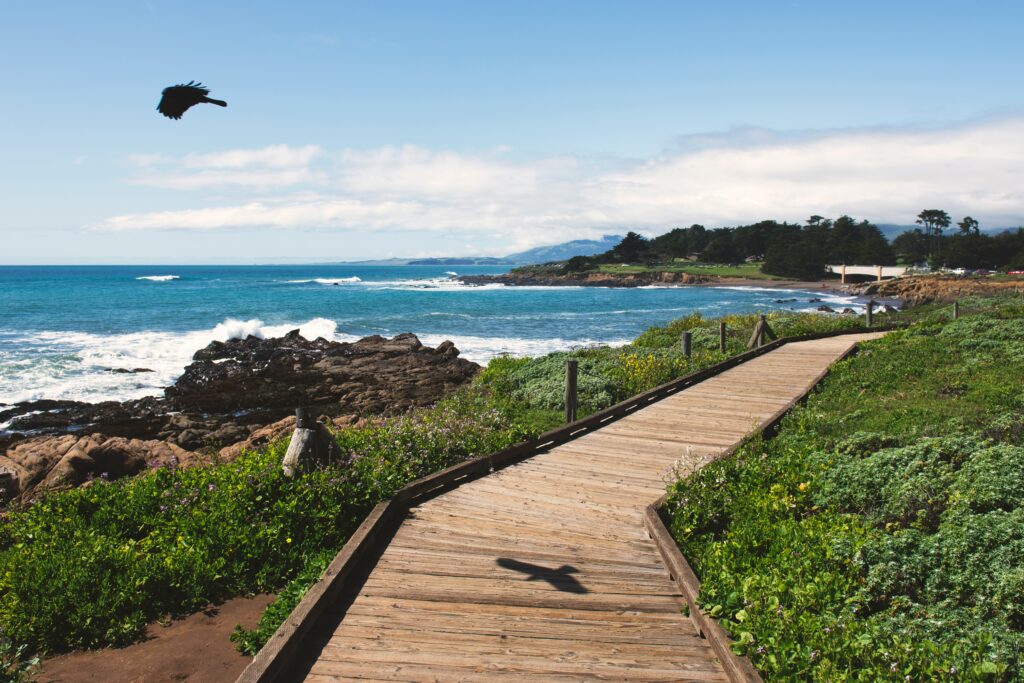
9. Morro Bay
Morro Bay is a working harbor town dominated by Morro Rock — a 581-foot volcanic plug, one of a chain formed roughly 23 million years ago. Climbing it is illegal for the general public: it is a protected reserve for peregrine falcons, and it is a sacred site to both the Salinan and Chumash peoples.
The estuary behind the rock is the real attraction. It’s calm, shallow, and full of sea otters, which makes Morro Bay the best kayaking town on this list for people who have never kayaked.
Base here if: you want wildlife, calm water and rates well below Cambria or Carmel.
Skip if: you want a glamorous beach town. Morro Bay is unpretentious and slightly weathered, which is most of its charm.
10. Pismo Beach
Pismo has a long flat beach, a pier, and the most affordable lodging on the central coast. It’s also the only town in California where you can legally drive on the sand: Oceano Dunes SVRA is open for vehicle day use from 7 a.m. to 10 p.m. at $5 per vehicle, with entry kiosks at Grand Avenue and Pier Avenue. Access rules here have changed repeatedly in recent years, so confirm current conditions before building a trip around it.
From November through February, the Monarch Butterfly Grove at 445 South Dolliver is free, open sunrise to sunset, and clusters monarchs in eucalyptus by the thousand. Manage expectations: state parks notes recent counts are down roughly 90% from 25 years ago, so it is smaller than the photographs suggest — and still worth seeing.
Base here if: you’re watching the budget, or you want dunes and a wide beach.
Skip if: you want a refined town center.
Southern California: warmer water, higher prices, more people
11. Santa Barbara
If you can pick only one Southern California base, Santa Barbara is the strongest. It’s a genuine city with a red-tiled historic core, a wharf, a mile of walkable waterfront, a serious restaurant scene, and mountains directly behind it — and because the coastline turns east here, the beaches face south, which means calmer water and more sun than the exposed coast further north.
It is not cheap. But it’s the rare town on this list where you could spend a week without a car.
Base here if: you want one place that handles couples, families, food and beach without compromise.
Skip if: you’re on a tight budget — try Ventura, 45 minutes south, instead.
12. Ventura
Ventura is what Santa Barbara costs half as much to be. It has a walkable Main Street, a historic mission, a long pier, consistent surf, and considerably less polish — which for a lot of travelers is a fair trade.
Its distinguishing feature is access. Channel Islands National Park is headquartered here at 1901 Spinnaker Drive, and the park charges no entrance fee at all. You reach the islands by boat, so the cost is the crossing, not the park — and the islands themselves are as undeveloped as anywhere on the California coast.
Base here if: you want Southern California beach access at a workable price, or the Channel Islands are on your list.
Skip if: you want somewhere manicured.
13. Malibu
Malibu is 21 miles of coastline rather than a town, strung along the Pacific Coast Highway with no real center. The beaches are the reason to come, and they are genuinely excellent — Zuma for sand, El Matador for rock formations and photographs, Point Dume for the headland walk and winter whale watching.
This is where the tide line rule matters most. Many Malibu beaches are backed by private homes, and the dry sand in front of some of them is private property — but the wet sand is public, and there are marked public accessways between the houses. The Coastal Commission’s Malibu access guide lists them by street address. Use it, and don’t be talked off a beach you’re entitled to be on.
Parking is the real obstacle: lots fill early on summer weekends and PCH shoulder parking is heavily enforced.
Base here if: you have a car, a budget, and want the beaches themselves to be the trip.
Skip if: you want walkability. Everything in Malibu requires driving.
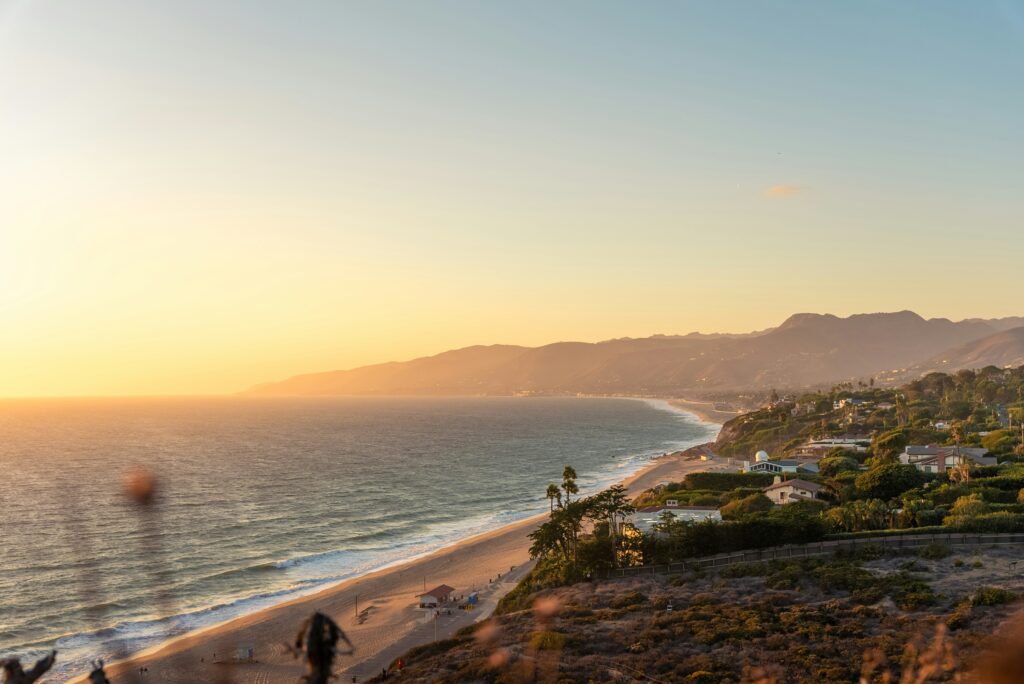
14. Manhattan Beach
Manhattan Beach is the most pleasant place to stay near LAX, twenty minutes from the terminal, and it quietly does everything well: a wide beach, a short pier, a walkable downtown of restaurants sloping down to the sand, and the Strand bike path running the length of the South Bay.
It’s expensive and residential, and it has very little in the way of tourist attractions — which is exactly why people like it.
Base here if: you’re flying in or out of LAX, or you want a real neighborhood rather than a resort strip.
Skip if: you want a bargain or a lot to do beyond the beach.
15. Huntington Beach
Huntington Beach trades on surf and mostly earns it. The pier runs 1,856 feet — among the longest public piers on the West Coast — and the US Open of Surfing takes over the south side of it each summer, drawing one of the biggest crowds in competitive surfing.
The beach itself is wide, flat and long, with fire rings, a paved bike path and easy parking by SoCal standards. It’s a good beach-day town and a mediocre sightseeing one.
Base here if: you want to surf, or you want a straightforward beach holiday with parking that works.
Skip if: you want charm. Huntington is functional and a bit generic away from the sand.
16. Laguna Beach
Laguna is the most scenic town in Orange County: a string of coves separated by headlands, with a walkable downtown of galleries and a genuine arts history. The tide pools here are among the best in Southern California, protected as marine reserve — look, photograph, leave everything where it is.
Its summer signature is the Pageant of the Masters, a living-tableaux production where performers pose inside recreations of famous paintings. It runs nightly at 8:30 p.m. from July 9 to September 4, 2026, at the Festival of Arts on Laguna Canyon Road, and a ticket includes unlimited entry to the Festival of Arts fine art show all summer. Book early; it sells out.
Parking is Laguna’s weak point — the coves have small lots that fill by mid-morning in summer.
Base here if: you want the prettiest coastline in Orange County and will pay for it.
Skip if: you’re traveling in August without a booking.
17. Coronado
Coronado sits across the bay from downtown San Diego, reached by a high bridge or a ferry, and it has the most forgiving beach on this list: wide, flat, gently shelving, with sand that sparkles from naturally occurring mica. Water temperatures are the warmest in California, which still isn’t warm by Florida standards but is swimmable through summer without a wetsuit.
The town is walkable, the Hotel del Coronado anchors the beachfront, and downtown San Diego is fifteen minutes away when you want a city.
Base here if: you’re traveling with young children, or you want the most reliable beach weather in the state.
Skip if: you want dramatic coastline. Coronado is flat and civilized, not wild.
Three more that nearly made the list: Encinitas for a low-key North County San Diego surf town, Avalon on Catalina Island if you want a genuine island stay, and Santa Monica if you want the beach with a major city attached.
Which town should you base in?
- First time, one week, want the classic version: Santa Barbara, with a two-night detour to Monterey or Carmel if you’re driving.
- Family with young kids: Coronado for the water, Santa Cruz for the Boardwalk, Ventura for the price.
- Highway 1 road trip: Base three nights around Monterey or Carmel and three around Cambria or Morro Bay. Now that Big Sur is open again you can drive it in one continuous run.
- Lowest cost: Pismo Beach on the central coast, Ventura in the south.
- Cold-water scenery, no crowds: Mendocino or Bodega Bay.
- Flying in and out of LAX with two days: Manhattan Beach. Don’t attempt Big Sur.
- Surfing: Santa Cruz in the north, Huntington Beach in the south.
- Whale watching: Monterey Bay for year-round variety; Point Dume in Malibu and the Mendocino headlands for winter and spring gray whales from land.
What to know before you go
Northern and Southern California are different climates, not variations on one. The north coast is cold and often foggy even at the height of summer; SoCal water rarely gets genuinely warm but is swimmable from roughly June to October. Bring layers for anywhere north of Santa Barbara in any month.
June Gloom is real. Coastal Southern California frequently sits under low cloud through late May and June, burning off inland by afternoon but not always at the shore. Late August through October is the most reliably sunny window on the SoCal coast — and cheaper than July.
Parking is the hidden cost. Budget for it in Laguna, Malibu, Carmel, Capitola and anywhere with a pier. State beach day-use fees stack up quickly; the Golden Poppy pass helps in the centre and north but not at busy Southern California beaches.
Check Highway 1 before a Big Sur run. The road reopened in January 2026, but Caltrans has been explicit that winter storms can still close sections temporarily and construction delays continue. Check Caltrans QuickMap the morning you drive it.
Rip currents and sneaker waves cause the coast’s serious accidents, particularly on the north coast around Bodega Bay and Sonoma Coast State Park. Swim near lifeguards, and treat posted warnings as literal.
When to go
Summer (June–August) is warmest and busiest, with the highest rates and, in Southern California, a reasonable chance of grey mornings.
September and October are the best months on most of the coast: the marine layer eases, water is at its warmest, and crowds drop after Labor Day. If you’re choosing blind, choose these.
Winter (December–March) is the north coast’s dramatic season — storm surf, whale migration, empty inns — and the cheapest time in the south, with the caveat that rain and Highway 1 closures are most likely then.
Spring brings wildflowers on the bluffs and the northbound gray whale migration, but also the beginning of the marine layer in the south.
Common questions
What’s the cheapest beach town in California to visit? Pismo Beach and Ventura consistently offer the lowest lodging costs of the towns here, with Morro Bay close behind. Cheapest of all is the north coast off-season, though you trade weather for it.
Can you drive the whole California coast on Highway 1? Now, yes. The Big Sur section between Monterey and San Luis Obispo counties reopened on January 14, 2026, after nearly three years closed. Highway 1 isn’t continuous for the entire state — it merges with US 101 in places — but the coastal drive is whole again.
Are California beaches free and public? The wet sand is public statewide, below the mean high tide line. Dry sand can be private, though many parcels carry public access easements. What usually costs money is parking, not entry.
Which beach town has the warmest water? Coronado and the San Diego area, warmest from roughly July through September. Water temperatures rise steadily as you move south.
How many days do you need for a California coast road trip? Seven to ten to do the full length without rushing. For one region, four nights is comfortable — the central coast between Monterey and Pismo Beach is the best-value stretch if you only have that.
Which town is best for a first visit? Santa Barbara for a single base; Monterey if you’d rather be north and are planning to drive Big Sur.
Leave a Reply