
Oregon’s coast runs 363 miles, and Highway 101 threads nearly all of it. That length is the reason most trips go wrong: people pick a town by photograph, then spend the week driving. Choosing well means matching a town to the kind of trip you actually want — a two-night escape from Portland, a full north-to-south road trip, a storm-watching weekend, a family base with a rainy-day backup plan.
This guide covers 15 Oregon beach towns from Astoria to Brookings, what each one is genuinely good at, and which to use as a base. It also flags a change that caught a lot of visitors out this year: as of March 30, 2026, Oregon State Parks added day-use parking fees at more than a dozen coastal spots that used to be free.
One thing that applies everywhere: the beaches themselves are public. The 1967 Oregon Beach Bill, signed by Governor Tom McCall and upheld by the Oregon Supreme Court in Thornton v. Hay two years later, guarantees public access to the shore up to the vegetation line. There is no such thing as a private beach in Oregon. Hotels can own the view; they cannot own the sand.
Quick guide: which Oregon Coast town fits your trip
| Town | Region | Best for | Nearest gateway | Approx. drive (est.) |
|---|---|---|---|---|
| Astoria | North | History, food, rainy-day museums | Portland | 2 hrs |
| Seaside | North | Families with young kids, arcades, walkable | Portland | 1.5 hrs |
| Cannon Beach | North | First-time visitors, photography, short walks | Portland | 1.5 hrs |
| Manzanita | North | Quiet beach time, few crowds | Portland | 2 hrs |
| Pacific City | North | Surfing, dunes, a compact one-stop base | Portland | 2 hrs |
| Lincoln City | Central | Budget lodging, kites, glass floats | Portland | 2 hrs |
| Depoe Bay | Central | Whale watching, storm watching | Portland | 2.5 hrs |
| Newport | Central | The strongest all-round family base | Portland | 2.5 hrs |
| Yachats | Central | Tide pools, dramatic rock, slow trips | Eugene | 2 hrs |
| Florence | Central | Sand dunes, old-town dining | Eugene | 1.5 hrs |
| Coos Bay / Charleston | South | Three state parks in a row, winter lights | Eugene | 2.5 hrs |
| Bandon | South | Sea stacks, golf, sunsets | Eugene | 3.5 hrs |
| Port Orford | South | Solitude, working harbor, diving | Medford | 3.5 hrs |
| Gold Beach | South | Rogue River jet boats, fishing | Medford | 3.5 hrs |
| Brookings | South | Mild weather, the Boardman corridor | Crescent City, CA | 45 min |
Drive times are rounded estimates for normal conditions and exclude stops. Check ODOT’s TripCheck before any winter trip — Highway 101 closes for landslides and flooding most years.
North Coast: closest to Portland, busiest in summer
1. Astoria
Astoria sits at the mouth of the Columbia River rather than on open ocean, which makes it the odd one out and the best bad-weather town on the coast. It has a working port, Victorian houses stacked up a hillside, and more indoor things to do than anywhere else on this list.
The Astoria Column is the orientation stop: a 125-foot tower with 164 steps to an observation deck and a spiral mural covering regional history from the Columbia’s European “discovery” through the railroad era. Parking is $10 per vehicle and the pass is good for a full year, which is unusual enough to be worth knowing if you plan to return. The park is open daily, 5 a.m. to 10 p.m.
Base here if: you want restaurants and museums as much as beach, or you’re traveling in December and want a plan B for three days of rain.
Skip if: you want to walk out of your hotel onto sand. The nearest ocean beaches are a short drive west at Fort Stevens and Warrenton.
2. Seaside
Seaside is the coast’s old-fashioned resort town: a paved oceanfront Promenade, an arcade, saltwater taffy, and a wide flat beach that suits small children. It is unapologetically commercial, and that is the point — it is the easiest coastal town to visit with kids who want something to do at 4 p.m. when it starts raining.
It is also about 80 miles from Portland, roughly 90 minutes on Highway 26, which makes it a genuine day trip.
Base here if: you’re traveling with kids under 10, or you want the most lodging choice per dollar on the north coast.
Skip if: you’re after quiet. Summer weekends here are loud.
3. Cannon Beach
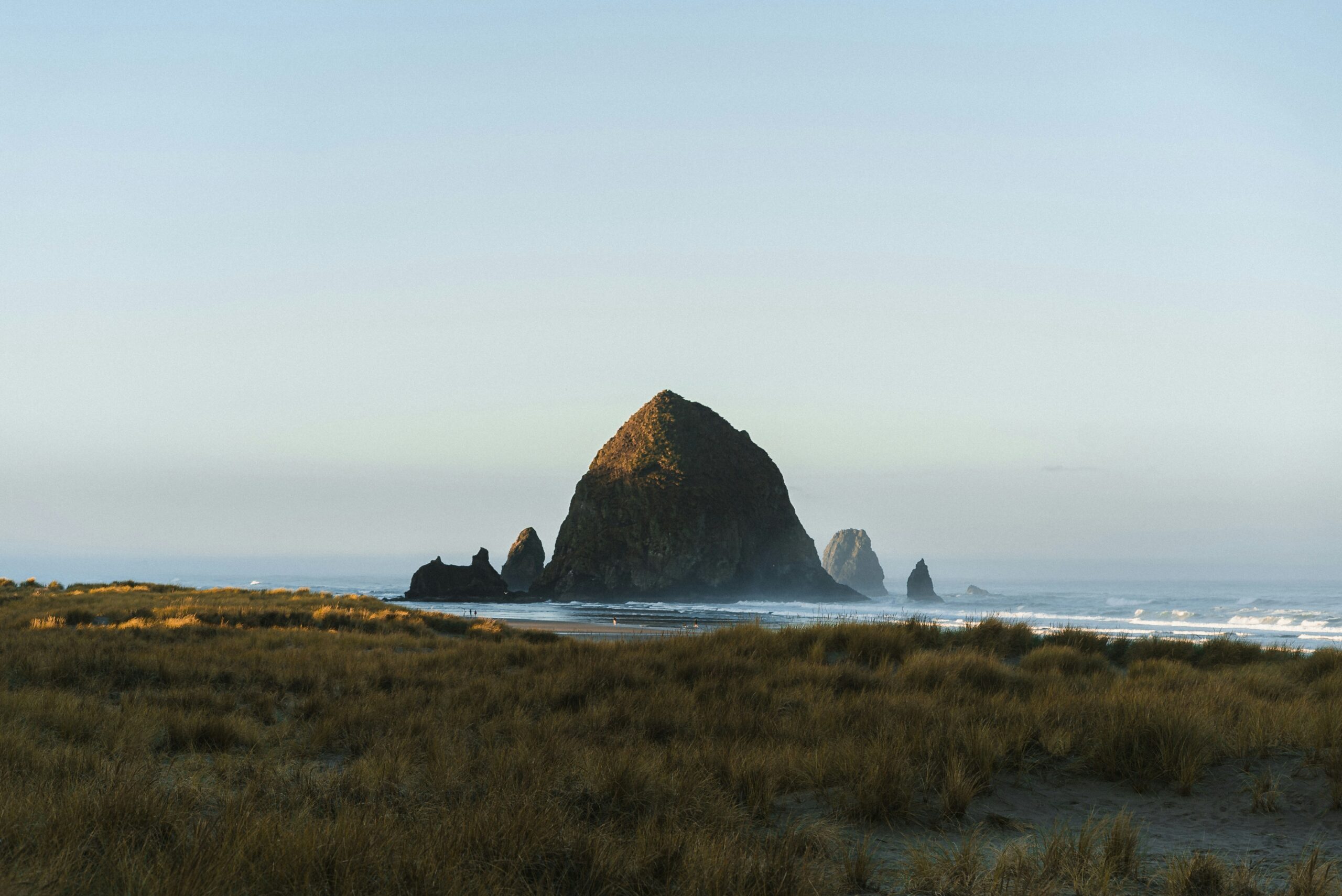
Cannon Beach is the photograph most people have in their heads when they think “Oregon Coast,” and it earns it. Haystack Rock stands 235 feet off the beach and is walkable at low tide.
What most guides leave out is that the rock is regulated. It has been an Oregon Department of Fish and Wildlife Marine Garden since 1990 and is protected within the Oregon Islands National Wildlife Refuge. Collecting anything from the tide pools is prohibited, and climbing above the barnacle line that marks mean high tide is not allowed. Tufted puffins, common murres, pigeon guillemots and black oystercatchers nest on the rock, generally between March and September — bring binoculars in early summer and you will see them without leaving the sand.
Time your visit to the tide table, not the clock. At high tide the tide pools are simply gone.
Base here if: it’s your first Oregon Coast trip and you want the classic version, with good food and a walkable town center.
Skip if: you’re on a budget. Lodging here is pricier than in most neighboring towns, and summer weekends book out early.
4. Manzanita
South of Cannon Beach over Neahkahnie Mountain and a fraction as busy, Manzanita is a small town at the foot of the headland with a long, wide beach and almost no commercial clutter. There is a short main street, a handful of good places to eat, and not much else — which is the appeal.
Base here if: your idea of a coastal trip is reading, walking and doing very little.
Skip if: you need restaurants open late or entertainment for restless teenagers.
5. Pacific City
Pacific City is built around Cape Kiwanda and a fishing tradition you can still watch happen. Commercial salmon fishing collapsed in Nestucca Bay by 1926, and local fishermen switched to dories launched straight off the open beach through the surf. A small recreational fleet still does it.
The cape itself is a sandstone headland with a big dune you can climb for the view. Note that Bob Straub State Park, on the spit south of town, is one of the parks that began requiring a day-use parking permit on March 30, 2026.
Base here if: you want a compact base with surf, a dune and a brewery within walking distance of each other.
Skip if: you want variety. This is essentially one beach and one headland.
Also worth a stop on the north coast, even though neither made this list: Tillamook, where the Tillamook Creamery is free to enter and open 10 a.m. to 6 p.m. daily, and Rockaway Beach, which has seven miles of sand and cheaper lodging than its neighbors.
Central Coast: the best all-round bases
6. Lincoln City
Lincoln City stretches about seven miles along the highway and has no real center, which is its main weakness. Its strengths are practical: the widest range of affordable lodging on the central coast, reliable wind for kite flying, and the Finders Keepers glass float program.
Finders Keepers is genuinely well run. More than 3,000 hand-blown glass floats are hidden on the beach each year by volunteers, placed above the high tide line and below the embankment, anywhere along the stretch from Roads End to Siletz Bay. If you find one, it’s yours — the limit is one per household per year, and floats are never hidden in beach grass. Registering a found float gets you a certificate naming the artist who made it.
Roads End State Recreation Site, at the north end, now requires a day-use parking permit.
Base here if: you’re watching the budget or traveling with a group that wants space.
Skip if: you want a walkable town. You will drive between everything here.
7. Depoe Bay
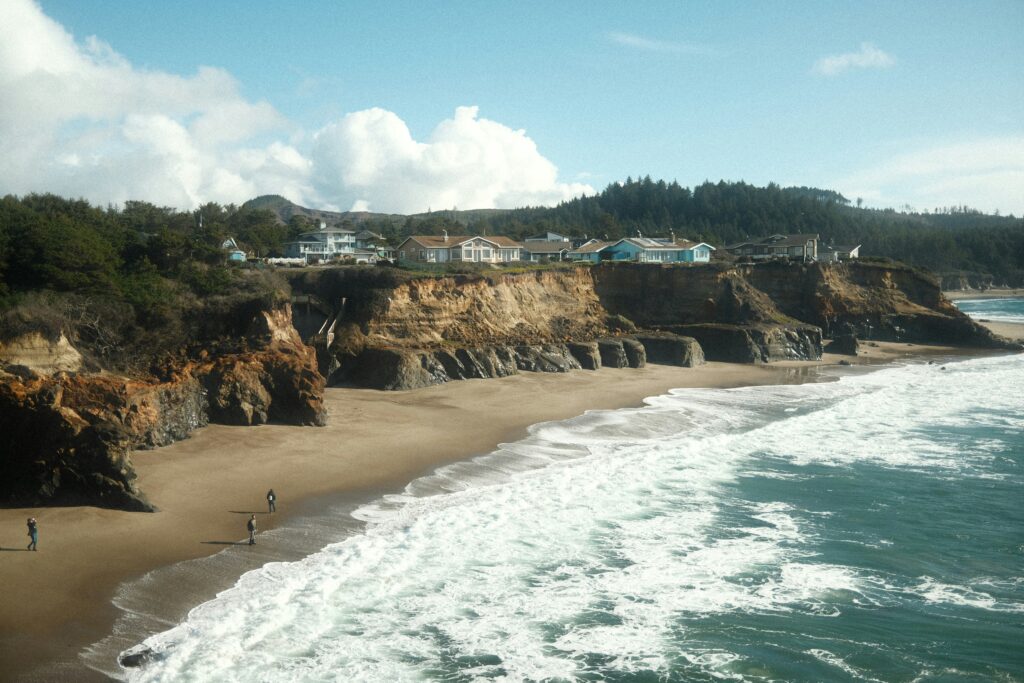
Depoe Bay is a six-acre harbor — the town bills it as the world’s smallest navigable harbor — with a population of about 1,500 and a seawall that puts you directly above the water. It is the coast’s whale-watching headquarters.
Gray whales pass southbound from mid-December through mid-January and northbound from late March into June, and roughly 200 whales stay off the Oregon coast through the summer, with the central coast active from June into mid-November. Oregon State Parks staffs 15 coastal sites with trained volunteers during Whale Watch Weeks in late December and late March.
One important note for late-2026 trips: the state’s Whale Watching Center in Depoe Bay is closed for repairs from August 17 through October 31, 2026, and the viewing area is closed with it. Outside that window it normally runs March through December, noon to 4 p.m., Wednesday through Sunday. Call 541-765-3304 to confirm before you count on it. The seawall itself stays open, and charter boats operate from the harbor regardless.
Base here if: whales are the reason for the trip, or you want a small town with an ocean-facing room.
Skip if: you need a beach outside your door. Depoe Bay is rock, not sand.
8. Newport
If you can only pick one base on the whole coast, Newport is the strongest argument. It has a working bayfront with sea lions hauled out on the docks, a real harbor, a lighthouse, an aquarium, and enough lodging and restaurants to absorb a bad-weather day without anyone getting bored.
The Oregon Coast Aquarium is open 10 a.m. to 5 p.m. from Labor Day weekend through Memorial Day weekend, and 10 a.m. to 6 p.m. in summer, closed only on December 25. Admission is tiered by day: adults pay $29.95 on weekdays and $34.95 Friday through Sunday, seniors and 13–17s $23.95 or $28.95, children 3–12 $19.95 or $24.95, under-3s free. Going midweek saves a family of four about $20.
Just north of town, Yaquina Head Outstanding Natural Area is run by the Bureau of Land Management and charges $7 per vehicle for a three-day pass, or $15 annually; walking or cycling in is free. It’s open 8 a.m. to 6 p.m. Monday through Thursday and to 7 p.m. Friday through Sunday, with the interpretive center open 10 a.m. to 4 p.m. Be aware that harbor seal pupping from mid-May to mid-June and seabird nesting from May through September can close Cobble Beach and the tide pools at short notice.
Agate Beach and Devil’s Punchbowl, both just outside town, joined the paid-parking list in March 2026.
Base here if: you want one town that covers families, food, weather contingencies and marine wildlife.
Skip if: you want somewhere small and quiet.
9. Yachats
Yachats is a town of about a thousand people wedged between forest and volcanic rock, and it is the best tide-pooling base on the coast. Two miles south, Cape Perpetua rises more than 800 feet above the water, and the sea does theatrical things at its base.
Thor’s Well, Devil’s Churn and the Spouting Horn are all here. They are also the most commonly mistimed attractions on the Oregon Coast. All three work best in the window from roughly an hour before high tide to an hour after — at low tide Thor’s Well is an unremarkable hole. They are genuinely dangerous at high tide and during winter storms, and people are injured on these rocks. Watch from above, and never turn your back on the water.
Base here if: you want dramatic coastline and don’t need nightlife.
Skip if: you’re traveling with young children who need sand rather than basalt.
10. Florence
Florence has a restored Old Town on the Siuslaw River with good restaurants, and it sits at the northern end of the Oregon Dunes National Recreation Area, which runs 40 miles south to Coos Bay. This is the only place on the coast where the landscape stops looking like the Pacific Northwest and starts looking like the Sahara with fog.
North of town, Sea Lion Caves is a privately run attraction built around what it describes as America’s largest sea cave. It’s open daily 9 a.m. to 5 p.m., closed Thanksgiving, Christmas Eve and Christmas Day, with free parking. Admission is $18 for adults, $17 for seniors, $12 for children 5–12, and free under 5. Carl G. Washburne Memorial State Park, further north on 101, now requires a day-use parking permit.
Base here if: you want dunes, or you’re coming from Eugene and want the shortest drive to the ocean.
Skip if: classic sea stacks and headlands are what you came for. Those are north and south of here.
South Coast: fewer people, longer drives, better weather
The southern third of the coast is the part most visitors never reach, mainly because it is four to six hours from Portland. It rewards the drive with emptier beaches and, in Brookings, measurably milder weather.
11. Coos Bay and Charleston
Coos Bay is the largest city on the Oregon Coast and is not, in itself, scenic — it’s a working port. Charleston, the fishing village on the far side of the bay, is where you actually want to be, because three state parks sit in a row along the Cape Arago Highway: Sunset Bay, Shore Acres and Cape Arago.
Shore Acres, a former timber baron’s estate with formal gardens on a cliff, hosts the coast’s biggest winter event. Holiday Lights runs November 26 through December 31, 2026, with timed entry at 4:30, 5:30, 6:30 and 7:30 p.m. Both entry time and parking must be reserved in advance, and parking is $10 per vehicle unless you hold a 12-month permit, a veterans or foster family pass, a current camping receipt or an Oregon Pacific Coast Passport. Reservations opened June 1; a rolling seven-day window releases more spots starting November 19. This sells out — do not drive down assuming you can pay at the gate.
Base here if: you want three genuinely different parks within fifteen minutes of each other, or you’re coming for the lights.
Skip if: you want a pretty town. Charleston is functional.
12. Bandon
Bandon has the most photogenic beach on the Oregon Coast and comparatively few people on it. Sea stacks — Face Rock, Table Rock, Wizard Hat — stand close enough to shore to walk among at low tide, and the light at sunset does something to them that the north coast can’t match.
It’s also a golf destination. Bandon Dunes draws players from well beyond Oregon to its links-style courses, and that sustains a level of lodging and dining in town that a place this size would not otherwise support.
Base here if: you want the scenery of Cannon Beach without the crowds, and you don’t mind the extra driving.
Skip if: you have two days and are starting from Portland.
13. Port Orford
Port Orford is the least visited town on this list and the most distinctive. Its fishing boats aren’t moored in a harbor — there isn’t one. They are lifted out of the water by crane at the end of each trip and parked on trailers on the dock, an arrangement you will not see anywhere else on this coast. Battle Rock sits at the end of the main street, and Cape Blanco, a few miles north, is among the westernmost points in the contiguous United States. Cape Blanco State Park joined the paid day-use parking list in March 2026.
Base here if: you want a town that feels genuinely remote and don’t need much from it.
Skip if: you want choice. Port Orford has very few beds and very few restaurants, and some close midweek off-season.
14. Gold Beach
Gold Beach sits where the Rogue River meets the Pacific, and the river is the reason to come. Jet boats run upstream from the harbor to Agness through the Wild and Scenic section of the Rogue — one of the last river mail routes in the United States, a service that began as a trial water route in 1895. The Rogue was among the original eight rivers protected under the Wild and Scenic Rivers Act of 1968.
Trips are seasonal and operator schedules shift year to year, so book directly and confirm dates before building a trip around them.
Base here if: you want to get off the coast and onto a river for a day.
Skip if: you’re visiting in winter, when most boat operations pause.
15. Brookings
Brookings sits just north of the California border in a pocket of unusually mild weather that locals call the Banana Belt, where offshore winds can push winter afternoons well above what the rest of the coast is getting on the same day.
Immediately north is the best stretch of road on the coast. Samuel H. Boardman State Scenic Corridor runs 12 ocean-facing miles between Brookings and Gold Beach, with turnout after turnout leading to viewpoints, arches and hidden beaches — Natural Bridges, Whaleshead, House Rock, Cape Ferrelo — linked by an 18-mile segment of the Oregon Coast Trail. Give it half a day, not half an hour.
Base here if: you’re combining Oregon with Redwood National and State Parks in California, or you want warmth.
Skip if: you’re short on time. This is the far end of a long road.
Which town should you actually base in?
Most trips fit one of these patterns.
- Weekend from Portland, first visit: Cannon Beach. Ninety minutes, the iconic scenery, and a walkable town. Manzanita if you’d rather it be quiet.
- A week with kids: Newport. Aquarium, sea lions, a lighthouse and a bayfront, plus enough indoor options for a wet day. Seaside if the kids are under about eight.
- Full coast road trip: Split it. Three nights north or central, three nights south, rather than driving 101 end to end and sleeping somewhere different every night.
- Storm watching, November to February: Depoe Bay or Yachats, where the coastline is rock and the waves have something to hit. Book a room facing the water and plan to spend a lot of it indoors.
- Lowest cost: Lincoln City or Rockaway Beach for lodging; Coos Bay for the south.
- Want to be alone: Port Orford, or Brookings outside summer.
A useful rule for a road trip: budget noticeably more time than a mapping app suggests. Highway 101 is two lanes for most of its length, drops to town speed limits repeatedly, and is full of reasons to pull over.
What to know before you go
Parking now costs money at more places than it used to. Oregon State Parks added day-use parking permit requirements at 22 more parks on March 30, 2026. Coastal additions include Agate Beach, Cape Meares, Devil’s Punchbowl, Fogarty Creek, Gleneden Beach, Oceanside Beach, Roads End, Bob Straub, Brian Booth, Carl G. Washburne, Governor Patterson, Cape Blanco and Umpqua Lighthouse. A daily permit is $10 for Oregon residents and $12 for out-of-state vehicles; an annual permit is $60 for residents. Arriving on foot or by bike is still free. If your trip includes more than five or six of these parks, the annual permit pays for itself — check the current list on the Oregon State Parks day-use parking page.
Dress for the coast, not for the state. Ocean temperatures here stay cold year-round, and coastal fog and wind are normal in July and August while the Willamette Valley bakes. Bring a windproof layer in every season. Swimming is for wetsuits.
Watch the tide table, not the forecast. Tide pools, Thor’s Well, the walk to Haystack Rock and most of the coast’s best moments are tide-dependent. Check a tide chart for the specific town before you plan the day.
Sneaker waves are a real hazard. Oregon beaches produce sudden, much larger waves without warning. Keep off exposed rocks and logs, never turn your back on the ocean, and take posted warnings seriously.
Winter closes roads. Highway 101 loses sections to landslides and flooding most winters, sometimes for days. Check TripCheck before you set out between November and March, and have an inland alternative in mind.
When to go
Summer, roughly July through early September, brings the most reliable weather and the most people, the highest room rates and genuine difficulty finding lodging on weekends without booking well ahead. Late September and early October are the best value: settled weather is still likely, crowds thin sharply after Labor Day, and rates drop.
Winter is the coast’s other good season if you go for the right reasons — storm watching, empty beaches, whales in late December, and Shore Acres lit up. Expect rain, book somewhere with a view, and accept that some small-town restaurants close midweek.
Spring is unpredictable but has the northbound whale migration from late March, when Whale Watch Week puts volunteers at 15 sites along the coast.
Common questions
How long does it take to drive the whole Oregon Coast? Highway 101 covers 363 miles in Oregon. It is technically a long day of driving, but a day would waste it. Four to seven nights lets you stop properly; five days is a reasonable minimum for the full length.
Which coastal town is closest to Portland? Seaside and Cannon Beach, both about 80 miles and roughly 90 minutes via Highway 26.
Can you swim at Oregon beaches? Not comfortably without a wetsuit. The Pacific here stays cold through summer, and rip currents and sneaker waves make open swimming risky. Wading, surfing in a wetsuit and tide pooling are the normal water activities.
Are Oregon beaches free to access? Yes. Under the 1967 Beach Bill the shore is public to the vegetation line statewide. What can cost money is parking at state park day-use lots and a few privately run attractions.
Where’s the best chance of seeing whales? Depoe Bay, from the seawall or a charter. Late December and late March coincide with the migration peaks and with Whale Watch Week, though the state’s Whale Watching Center building is closed for repairs until October 31, 2026.
Which town is best for a first visit? Cannon Beach for scenery in a short trip; Newport if you have longer or are traveling with children.
Leave a Reply